Guide · Computer vision
Building Real-Time CCTV Analytics with YOLO
Key takeaways
- Profile capture, inference and alerting separately; sample frames when the event permits it.
- Batch frames from several cameras into one model call for real-time throughput.
- Track identities (DeepSORT/ByteTrack) so deduplication can work at all.
- Deduplicate alerts in a Redis window per camera + track — noise kills operator trust.
By Prasanna Patil · published · updated
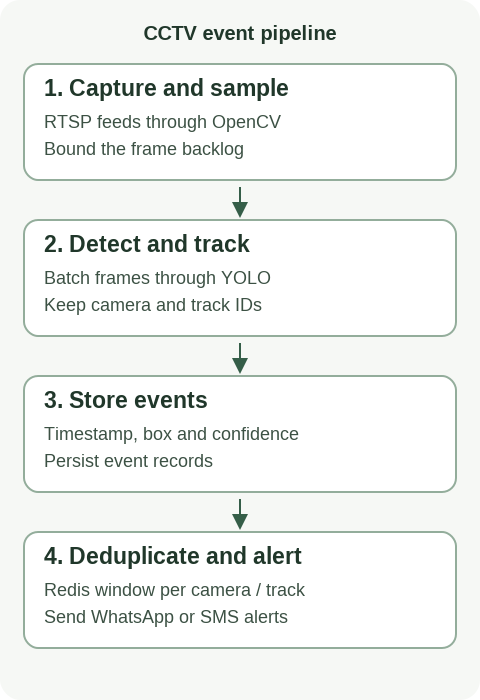
What we're building
A service that watches several CCTV feeds, detects people and crowd-density spikes, and suppresses repeated alerts within each camera feed. The numbers below come from the system I built for Smart India Hackathon 2023 (a finalist entry) and from the person detection and tracking pipeline I built on CCTV feeds at Zuneko Labs.
The CCTV case study gives the project context. The pipeline and code here explain the design; they are not a packaged implementation. The historical four-stream observation does not include a complete hardware, model-version and validation record, so it is not a reproducible benchmark or a capacity promise for another deployment.
The pipeline
RTSP feeds ─► OpenCV reader ─► sample to N fps ─► batch ─► YOLO ─► tracker ─► events (MongoDB)
 (per camera)   (reconnects)                       (GPU/CPU)  (DeepSORT/    │
                                                              ByteTrack)    ▼
dedup (Redis, 30 s) ─► alert (WhatsApp / SMS)- Read each stream in its own process and reconnect on failure — cameras drop more often than you expect.
- Sample. Don't process every frame. Decide the frame rate from what you need to catch.
- Batch frames from several cameras into one model call.
- Detect with YOLO; track so a person keeps one ID across frames.
- Store each event: timestamp, camera ID, track ID, bounding box, confidence.
- Deduplicate, then alert.
Throughput: what actually happened
Running four simultaneous streams in real time on a single machine, the frame queue backed up after about 90 seconds. Two changes fixed it: dropping to 5 fps per stream, and batching frames through the model instead of sending them one at a time.
Sampling creates a risk of missing short events or fast motion between processed frames. For the crowd monitoring task, steady throughput mattered; that does not establish recall for a different event such as a fall. Measure detection quality for the event and footage you will actually use.
Alert deduplication
A detector can emit the same tracked event on many frames. Without suppression, operators get repeated alerts. I used a Redis key per camera ID and track ID with a 30-second expiry on this build. That window trades repeated notifications against suppressing a genuine repeat; it is not a universal setting. Overlapping cameras still have separate track IDs, so this key does not merge incidents across cameras.
def maybe_alert(event):
    key = f"alert:{event.camera_id}:{event.track_id}:{event.kind}"
    # SET NX EX: only the first event in the window creates the key
    if redis.set(key, 1, nx=True, ex=30):
send_alert(event) # Twilio SMS / WhatsApp Business APIReserving the Redis key and sending a notification are separate operations. A send failure after the key is set can suppress a needed retry; a crash after a successful send can leave the outcome uncertain. A durable alert record, recoverable delivery state and downstream idempotency or reconciliation are needed when missed or repeated notifications are costly. The short sketch above only illustrates the window.
This deduplication logic and the alert pipeline were specifically called out in the hackathon judges' feedback.
Failure modes
- Queue backlog. If processing is slower than arrival, latency grows until alerts are useless. Watch queue depth, and drop frames rather than fall behind.
- Stream drops. RTSP connections die silently; the reader needs timeouts and reconnects.
- Identity switches. Without tracking, one person becomes many IDs and dedup by track fails.
- False positives from lighting changes, reflections and posters of people.
Limitations
- Accuracy depends heavily on camera placement, lighting and resolution; test on your own footage.
- Facial recognition carries legal and privacy obligations — in India, the Digital Personal Data Protection Act, 2023. Decide what you actually need to store.
- The numbers here come from one machine and four streams; more cameras need more hardware or edge devices.
Frequently asked questions
What frame rate do I need for real-time detection?
Far less than the camera produces. On the four-stream build, 5 fps per stream was enough for crowd monitoring once frames were batched — decide from what you need to catch, not from the camera's maximum.
How do I stop duplicate alerts from overlapping cameras?
A Redis window per camera ID and track ID suppresses repeated alerts within one feed — 30 seconds on this build. Tracking must come first. Overlapping cameras still produce separate IDs; cross-camera suppression needs an additional identity-association mechanism, not just this key.
YOLOv8 or a custom model?
Pre-trained YOLO handles people and common objects well. Anything specific to your site — uniforms, restricted zones, particular vehicles — needs labelled footage and fine-tuning.
Can this run on the edge instead of a server?
Yes — export the detector through ONNX to TensorRT and run on an NVIDIA Jetson. That trades model size and update convenience for on-site processing and lower bandwidth.
Primary documentation
Use the documentation for the versions you deploy; the examples above are explanatory sketches, not a version-pinned application.
- Ultralytics: multi-object tracking — Tracker configuration and persistence of track IDs.
- Redis: SET command — NX and expiry options used by the alert-window sketch.
Planning a video-analytics project?
Tell me about the cameras, the hardware and what you need to detect.